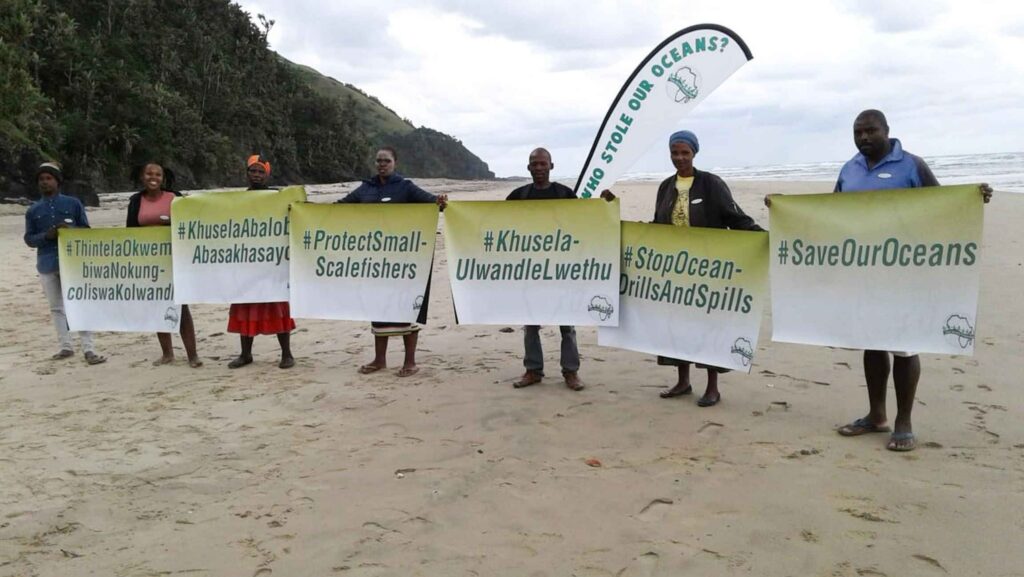
Cape Town – Court hearings unfold this week in the Western Cape High Court, small-scale fishers and coastal communities from across the Northern and Western Cape have united with civil society organisations The Green Connection and Natural Justice (the applicants) to resist oil and gas exploration in Block 5/6/7 – a marine region critical to their survival. Through the legal challenge, the applicants seek a judicial review of the Environmental Authorisation (EA) granted in 2023 to TotalEnergies for offshore drilling activities. They also fiercely oppose Shell’s bid to join the proceedings, raising urgent alarms over governance failures and environmental risks. The organisations are represented by environmental law firm, Cullinan & Associates Inc.


Coastal communities, small scale fishers and civil society organizations picketed outside Western Cape High Court against TEEPSA567 offshore oil and gas exploration project.
“This is not only a legal battle,” says small-scale fisher, Walter Steenkamp, “it’s a fight to defend our livelihoods, our culture, and the ocean that sustains us. As small-scale fishers, we face so many challenges but yet we are excluded from decisions that directly impact our futures. Offshore oil and gas projects pose a huge threat to the marine ecosystems we rely on for food and income. But it’s not just about economics – fishing is in our blood. It’s who we are. Our traditions, our identity, and our knowledge of the sea have been passed down through generations. If we lose our ocean, we lose our heritage.”
South Africa’s coastal communities, who have historically been dispossessed and marginalised, are calling for decision-making processes that do not compound historic inequalities by ignoring the very people whose futures are most at risk. Communities say it is time to challenge decisions that threaten their livelihoods and deepen environmental injustice.

According to McDaid, there is no legal basis for Shell to be joined to the proceedings – which challenges the government’s approval of TotalEnergies’ (TEEPSA) proposed offshore drilling activities. “Shell was neither part of the original EA application nor has there been any lawful transfer of the authorisation to the Dutch multinational. In fact, according to our calculations, the exploration right has already lapsed. Shell’s claim to a right that we believe no longer exists undermines proper environmental governance.”
Natural Justice Programme Manager, Melissa Groenink-Groves, further explains that Shell’s supposed interest in the matter is both premature and procedurally flawed. She says, “Total (or Shell) need both an exploration right and an environmental authorisation to conduct the exploration drilling. South African law permits only three renewals of an exploration right – each valid for two years – and that limit was reached in 2021. Their third renewal application should not be permitted to hang in perpetuity, just because Total waited until their third renewal to apply for its environmental authorisation.”


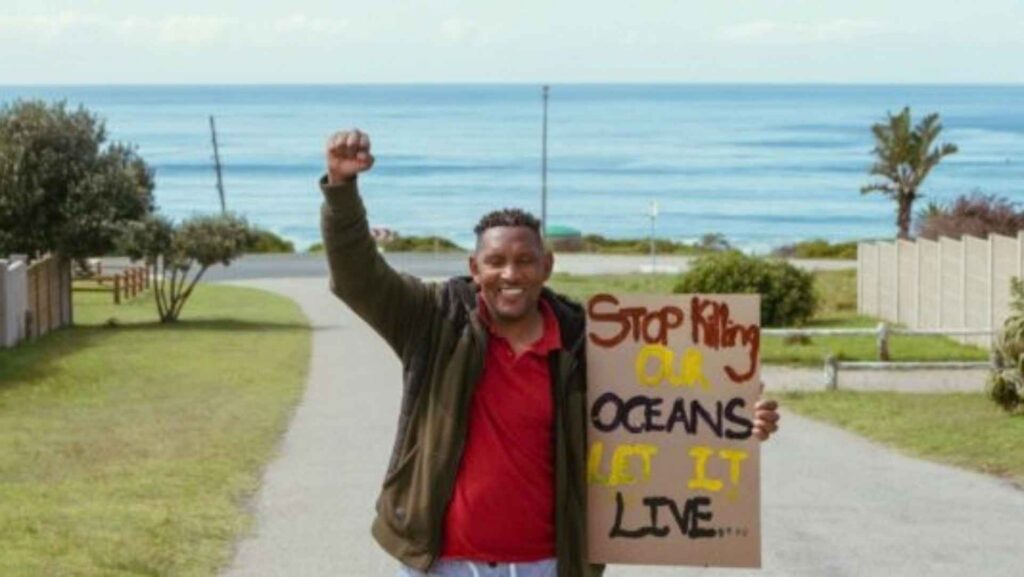
Coastal communities & activists in Eastern Cape picketed in solidarity with coastal communities against TEEPSA567 offshore oil and gas exploration project (left/top). Activists and civil society organizations picketed outside Total Energies office in Johannesburg and handed over an open letter signed by 110 organizations from across Africa (right/bottom).
The Environmental Authorisation was granted in 2023, and following an appeal to the Minister of Forestry, Fisheries and the Environment, The Green Connection and Natural Justice launched a judicial review application in the Western Cape High Court in March 2024. This was to challenge the decisions of the Director-General and the Minister. In April this year (2025), Total filed a “joinder application”, seeking to include Shell as a party in the legal proceedings concerning block 5/6/7.
“The Environmental Authorisation (EA) was granted without properly assessing the devastating impact an oil spill could have on small-scale fishers, without accounting for climate change, and without making oil spill contingency plans available as part of the environmental impact assessment process. It failed to meet legal standards under our coastal management laws, ignored cross-border environmental risks for our neighbours in Namibia. The Minister, in her appeal decision, also mistook the input from the Petroleum Agency as that of the decision maker. This is not good, strong environmental governance but rather seems like a recipe for disaster,” concludes Groenink-Groves.
The applicants argue that the government’s approval of the EA failed to assess the climate, ecological and socio-economic risks of offshore oil and gas activities, particularly on marginalised fishers who depend on marine health for survival. Dozens of small-scale fishers and coastal community members travelled from Northern and Western Cape to the Cape High Court to make their voices heard, while others held actions around the country, in solidarity.
“They ignore our voices and call it development. But how is it development if it destroys our livelihoods? Oil spills don’t care about borders. If there’s a blowout, it could wipe out our fish stocks, our tourism, everything. That’s not development – that’s devastation,” adds small-scale fisher, Emelin Mitchell.
Court hearings were streamed live on YouTube.
Judgment has been reserved in the matter.

BENDING OVER BACKWARDS, DMRE GIVES KARPOWERSHIPS ANOTHER BREAK
30 September 2021 was supposed to be the commercial close – a date set by the Department of Mineral Resources and Energy (DMRE) – for bidders in the Risk Mitigation Independent Power Producers Procurement Programme (RMI4P).
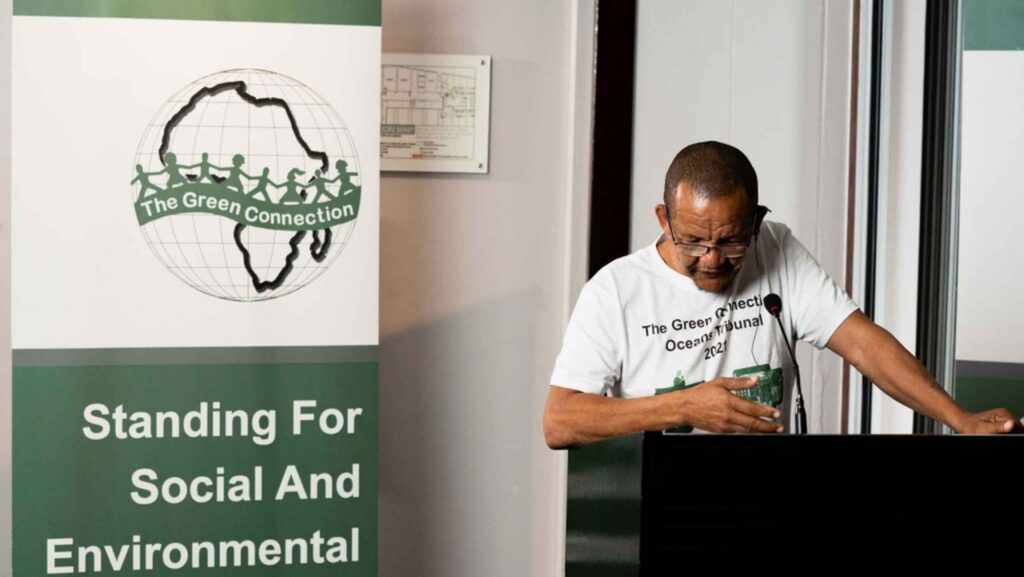
TOSACO EIA MET WITH PUSHBACK FROM CIVIL SOCIETY, TO PROTECT THE OCEAN AND SMALL-SCALE FISHER LIVELIHOODS
This week, The Green Connection submitted its comments critiquing several aspects of the Environmental Impact Assessment (EIA) process, particularly the lack of procedural fairness, as well as the conclusions reached – notwithstanding information gaps and scientific uncertainty – that should form part Tosaco Energy’s request to undertake various activities in Block 1, off the West Coast.

RECENTLY GRADUATED GREEN CONNECTORS, EQUIPPED FOR THE POLLS AND READY TO WEIGH-IN ON COP26
Following their recent graduation from The Green Connection’s Legacy Champions Programme, these newly empowered Green Connectors say they feel equipped with the necessary advocacy skills to make positive changes in their communities, starting with their vote in the local elections (1 November) and weighing in on the discussions around COP26 (which starts on 31 October) – as part of their efforts to oppose oil and gas developments in the country and offshore.
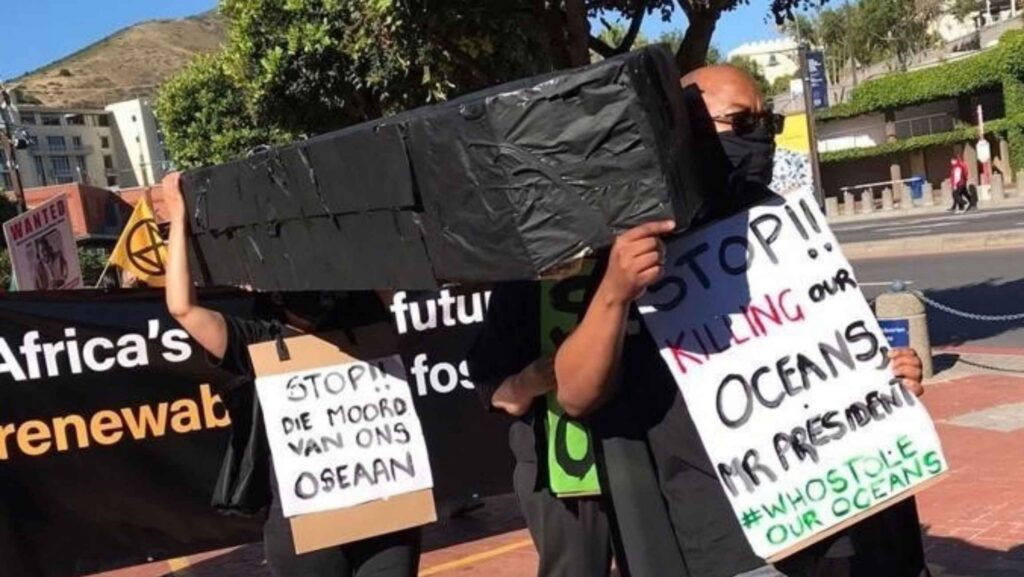
GREEN CONNECTION’S ‘FUNERAL FOR THE CLIMATE’ (AFRICAN ENERGY WEEK) AND COMMENT ON YESTERDAY’S BUDGET SPEECH
This week (10 November 2021), we joined other environmental defenders in Cape Town to peacefully demonstrate outside the African Energy Week #AEW2021 conference venue demanding an end to fossil fuels and the immediate pivot toward the just transition to a renewable energy future.
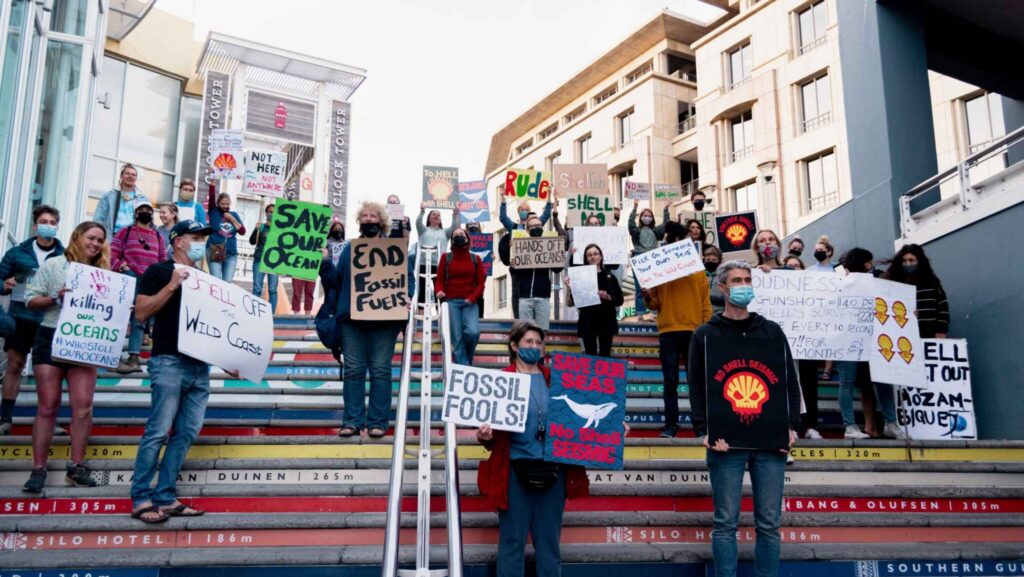
CLOSE TO 200 PEOPLE RISE AT CRACK OF DAWN TO PROTEST THE ARRIVAL OF SHELL’S SEISMIC MONSTER, AMAZON WARRIOR
On Sunday morning, (21 November 2021), before the crack of dawn, nearly 200 concerned environmental defenders took to the Waterfront to get a glimpse of Shell’s seismic testing vessel, Amazon Warrior, as it made its way into Cape Town harbour. The vessel travelled down the West coast of Africa, on its way to the Wild Coast, to conduct seismic surveys for an estimated five (5) months.
ENVIRONMENTALISTS DOUBLE-UP ON EFFORTS TO OPPOSE UPCOMING AND FURTHER SEISMIC TESTING IN SOUTH AFRICA’S OCEANS
As the groundswell of opposition against Shell’s upcoming 3D seismic survey off the Transkei builds, the Green Connection – an ecojustice NGO that supports small-scale fishers in advocating for their livelihoods – reacted with astonishment to a press statement issued by the Department of Mineral Resources and Energy (DMRE) on 9 December 2021.
