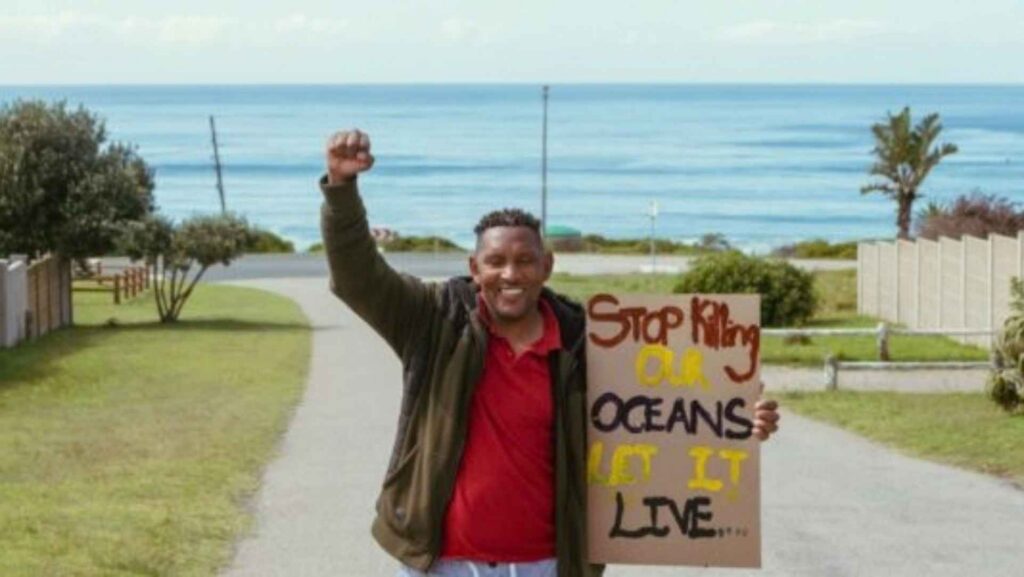
As COP29 sparks urgent global dialogues on phasing out fossil fuels, civil society in South Africa is taking a stand to ensure action meets ambition. In a fresh push, The Green Connection and Natural Justice have filed a supplementary founding affidavit (on 11 October), reinforcing their legal challenge against TotalEnergies EP South Africa (TEEPSA) and the government’s approval of exploratory oil and gas drilling in Block 5/6/7. Launched in March 2024, this review application seeks to halt what can be seen as a reckless disregard for South Africa’s climate commitments and the wellbeing of its coastal communities. This comes after the eco-justice organisations reviewed the record of the decision (on 13 August and 2 September, respectively) from the Minister of Forestry, fisheries and the environment, the Minister of Mineral Resources and Energy and the Director General: Mineral Resources and Energy.
The Green Connection’s strategic Lead, Liz McDaid highlights significant gaps in the decision-making process, citing inadequate consideration of long-term environmental risks tied to the project. She says, “There is evidence of procedural missteps, which raises a fundamental question: does oil and gas exploration off South Africa’s coast align with the country’s climate goals and the wellbeing of coastal communities? At a time when COP29 discussions are focusing on the urgent need for sustainable energy transitions, it is clear to us that this project lacks a thorough assessment of its environmental and social risks.”
A particularly concerning issue arises from the fact that the appeal response reports, required under the National Environmental Management Act (NEMA), were prepared by the Petroleum Agency of South Africa (PASA). McDaid argues that this is inappropriate because PASA’s mandate is to promote oil and gas exploration, while also being the regulator. She emphasises, “By relying on PASA’s responses, the Department of Mineral Resources and Energy (DMRE) failed to provide
independent reasoning in its decision-making. How can PASA remain impartial when its mission conflicts with the need for an unbiased environmental assessment? We believe that the process is fundamentally flawed and a violation of South Africa’s environmental laws.” Beyond procedural issues, The Green Connection and Natural Justice point to major shortcomings in the environmental impact assessment (EIA) conducted for the project. The scope of the EIA was limited to the immediate impact of the five exploration wells, without a comprehensive evaluation of the long-term consequences of potential oil or gas extraction. This narrow focus excluded important factors such as climate change implications, the future of the local fishing industry, and the broader economic and environmental impact of large-scale fossil fuel production.
McDaid says, “It makes no sense to assess only a small part of the project, ignoring the larger and inevitable impacts, if oil or gas is found. The goal is clearly to exploit these resources, and the long-term consequences, especially in terms of climate change, cannot be brushed aside.”
In support of their case, the organisations submitted an expert affidavit from Professor Mark New, who highlighted the risks posed by further fossil fuel extraction, particularly in the context of South Africa’s commitments to the Paris Agreement. The exploration project is set against the backdrop of a global climate crisis, where greenhouse gas emissions (GHG) must be curtailed, not increased. As part of its legal argument, The Green Connection asserts that the government’s decision fails to account for South Africa’s obligations to reduce emissions in line with the goal of limiting global temperature increases to 1.5°C.
In addition to concerns about the climate impacts, The Green Connection and Natural Justice highlight the glaring deficiencies in TEEPSA’s oil spill contingency plan. The report submitted by TEEPSA relied on assumptions based on an oil spill plan prepared for a different project (Block 11B/12B) in 2020, adjusted for the Block 5/6/7 location. McDaid says: “We are alarmed that the Minister allowed this project to proceed without a clear and detailed oil spill contingency plan. The assumptions used are outdated and speculative at best. Given the potential devastation an oil spill could cause to marine life and coastal communities, this lack of detail is simply unacceptable.”
The Green Connection and Natural Justice argue that both the oil spill contingency plan and the blowout contingency plan are crucial components that should have been fully developed and vetted before any authorisation was granted. “This is not just about environmental regulations – it’s about the livelihood of South Africans who depend on a healthy ocean. The risks cannot be ignored,” McDaid added.
The eco-justice organisations also question whether South Africa needs another petroleum project, given the country’s shifting energy landscape and commitments to renewable energy. “We have to ask, is this project necessary or desirable when we face the climate crisis head-on? Gas may be framed as a transition fuel, but the reality is, burning more fossil fuels only accelerates global warming. We also cannot avoid the harmful fugitive methane emissions which come from different natural gas production systems,” explains McDaid.
According to Professor New, methane – from fugitive emissions and other sources such as agriculture – is a powerful GHG. Although it breaks down in the atmosphere faster than CO2, it’s global warming potential is 80 times greater than that of CO2 when measured over a 20-year period, and 28 times greater when measured over 100-year period. Therefore, the argument that natural gas is a lower impact ‘transition fuel’ that should be exploited in place of oil and gas is untrue in most gas production cases, to date.
There is also a growing concern about the financial viability of these projects in the long term. With the world moving towards net-zero carbon emissions by 2050, fossil fuel projects could become “stranded assets” – investments that will no longer be profitable as global energy systems transition to renewables. The International Energy Agency has stated that reaching net-zero will require a complete transformation of the energy sector, and this raises serious questions about the wisdom of pursuing new oil and gas projects in South Africa.
David Mtshali from Natural Justice concludes, “This case is about holding the government and corporations accountable for decisions that will impact the environment, local communities, and future generations. The rate at which government issues exploration rights for oil and gas, undermines its commitment to a just energy transition and does not reflect the delicate balance (economic development that protects the environment) required under section 24 of the Constitution. We are hopeful that the court will see the flaws in this decision-making process and rule in favour of environmental justice.