Environmental justice organisation The Green Connection has written an open letter to President Cyril Ramaphosa about reports that Israeli-owned Navitas Petroleum LP is set to become operator of offshore oil and gas exploration Block 1 CBK in the Orange Basin off South Africa’s West Coast. The organisation believes that the proposed transaction raises questions about whether South Africa’s commercial decisions align with the principles underpinning its international stance on Israel and Palestine, including its ongoing case against Israel before the International Court of Justice (ICJ). The Green Connection’s letter has thus far been endorsed by thirty-five (35) civil society organisations,
and counting.
“The Green Connection is not calling for the transaction to be automatically rejected. It is urging government to provide clear political and policy leadership on commercial engagement involving Israeli-owned companies while South Africa continues to pursue accountability through international legal processes,” says Lisa Makaula, Advocacy Lead at The Green Connection.
Block 1 CBK is the northern-most offshore block on South Africa’s West Coast, extending about 250 kilometres west along the South Africa–Namibia maritime border and covering approximately 19 907 square kilometres. Media reports say Navitas Petroleum LP, through Navitas Petroleum Africa Limited, has agreed with Eco (Atlantic) Oil and Gas Ltd., through Azinam South Africa Limited, to acquire a 37.5% participating interest in Block 1 CBK and assume operatorship. If completed, Navitas and Eco Atlantic will each hold 37.5%, while Orange Basin Energies (Pty) Ltd will retain 25%.
South Africa instituted proceedings against Israel before the ICJ in December 2023, alleging violations of the Genocide Convention. The case remains before the Court, which has issued provisional measures. This includes requiring Israel to prevent acts prohibited under the Convention, enable humanitarian assistance and halt action that could bring about the physical destruction of Palestinians in Gaza.
“This is about far more than a single commercial transaction,” says Makaula. “South Africa earned international respect by taking the unprecedented step of asking the ICJ to hold Israel accountable under the Genocide Convention.
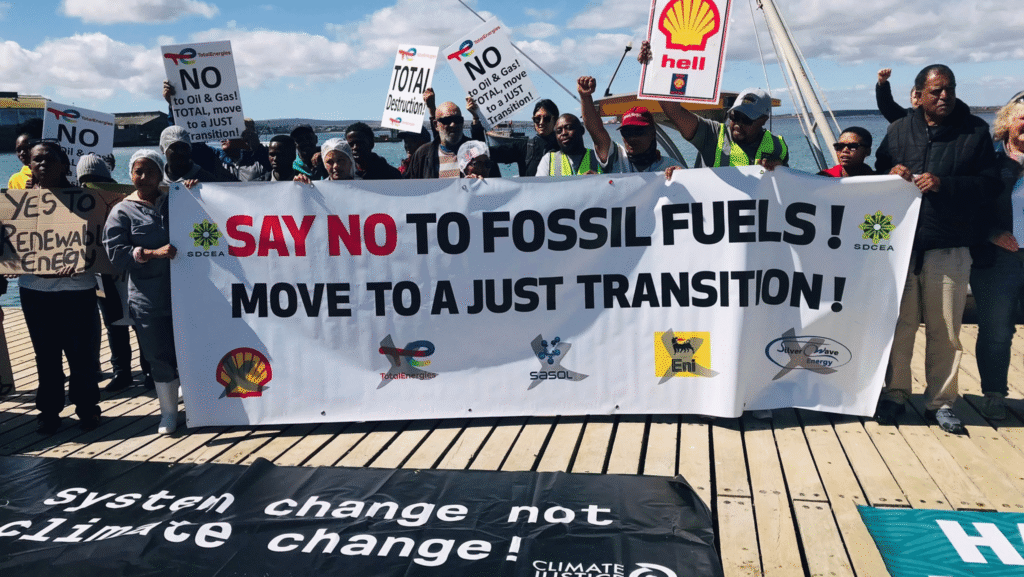
The eco-justice organisation also argues that the proposed transaction is inconsistent with South Africa’s commitments under the Just Energy Transition Partnership, which aims to accelerate a fair and equitable shift to cleaner energy rather than expand offshore oil and gas development. A just transition involves moving away from carbon-intensive fossil fuels that drive global warming and climate change, towards cleaner, more sustainable and safer energy sources.
Neville van Rooy, Outreach Coordinator and Ambassador at The Green Connection, says that offshore oil and gas decisions directly affect coastal communities. He says, “Small-scale fishing communities often carry the risks of offshore oil and gas development while seeing few promised benefits. Too often, decisions affecting our oceans are made without meaningful participation from the people whose livelihoods, culture and food security depend on healthy marine ecosystems.”
In its letter, The Green Connection calls on the Presidency to ensure that the government develops a lawful, transparent policy position on commercial engagement involving Israeli-owned entities, that is consistent with South Africa’s constitutional values, international obligations and stated foreign policy positions.
“We are not asking for political interference or automatic rejection,” says Makaula. “We are asking for any decision, including under section 11 of the Mineral and Petroleum Resources Development Act, to be made lawfully, transparently and with proper regard for South Africa’s constitutional values, international obligations and stated commitments.”
“This is ultimately about South Africa’s credibility,” says Makaula. “The world has looked to South Africa for principled leadership because of our willingness to stand up for justice. Today’s decisions will show whether our commitment to human rights, international law and justice extends beyond our words.”