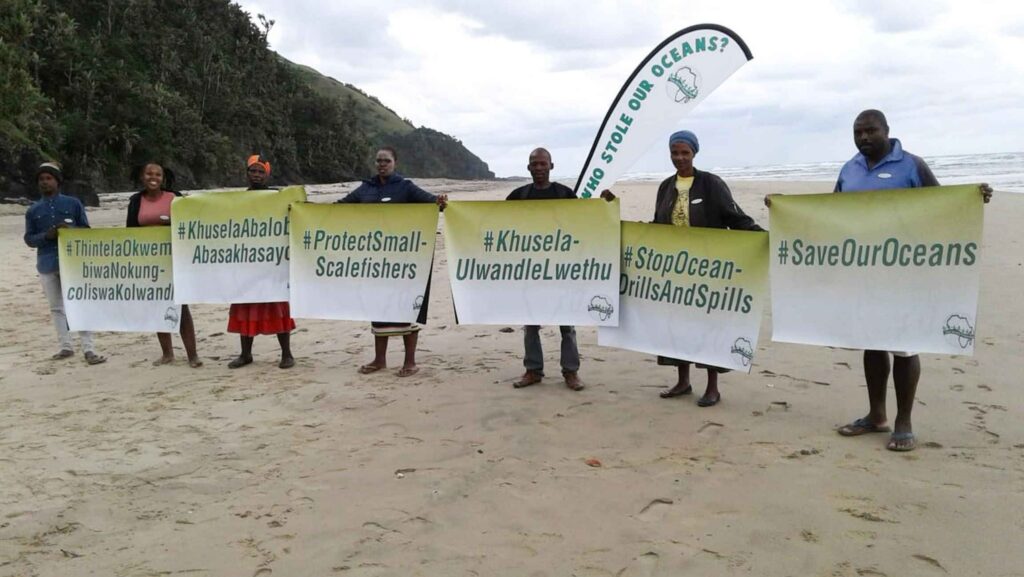
Fresh from their landmark victory in the Teepsa 5/6/7 case, where the courts set aside authorisation for another deep-water drilling project, Green Connection and Natural Justice are warning of an even bigger threat to people, the ocean and the climate. This time, the organisations are challenging TotalEnergies’ proposal to drill what would be the world’s deepest offshore well in the Deep Western Orange Basin (DWOB South). The Green Connection’s Strategic Lead, Liziwe McDaid says that the scale of the project is staggering, “If approved, this would mean drilling at depths of nearly 3,900 metres, only 211 km off the coast of Saldanha, home to many indigenous small-scale fisher families. It would be reckless to put their livelihoods and our marine heritage at risk.”
According to McDaid, the Draft Environmental and Social Impact Assessment Report (DESIAR) reveals several governance failures. “What is particularly concerning is how the report downplays the risk of catastrophic oil spills and makes unsubstantiated claims that a blow-out could be capped in just 20 days, while experts warn it could take months at these depths. A spill of that scale could devastate fisheries and wipe out tourism jobs and could even spread into Namibian waters. This month we celebrate our heritage, and this weekend the world turns to Coastal Clean-Up and Zero Emissions, yet this project could unnecessarily put people’s culture, the ocean, and climate action at risk if approved,” she explains.
“Some of the most concerning aspects of the DESIAR are that it seems to ignore cumulative climate impacts and appears to perpetuate injustice against marginalised communities, due to the lack of meaningful engagement with those who will likely be affected. Many fisher communities report that, as a result of meeting locations, they were not reached, while others report that they were only afforded limited consultation as crucial baseline data was not shared in accessible formats. This may undermine people’s constitutional rights, especially since this is yet another project that could lock South Africa into a costly, carbon-heavy path that may be wholly at odds with climate science and the country’s just transition commitments, and which could negatively impact the marine ecosystems that coastal communities rely on,” adds McDaid.
The DESIAR also appears to present inflated economic benefits, but most skilled jobs could go to foreign contractors, which may leave locals with only short-term, low-paid work. In contrast, coastal fishing and tourism proven, sustainable drivers of jobs and GDP could be placed at risk.
The organisations also emphasise that impacts on marine biodiversity are barely assessed, even though the deep ocean plays a critical role in regulating the climate and sustaining fisheries. Noise pollution is similarly overlooked, with the report dismissing the risks of seismic blasts and drilling noise that can disorient whales, drive fish from their feeding grounds, and threaten endangered turtles and seabirds.
Legal Advisor at The Green Connection, Shahil Singh adds, “The law is clear, Environmental Impact Assessments (EIAs) must consider the full life cycle of a fossil fuel project, not just the exploration phase. By failing to properly address this, the report could mislead the public into thinking exploration is harmless, when in reality it is often the first step towards large-scale oil and gas extraction. The recent Teepsa 5/6/7 judgment confirmed this principle, with the courts making it clear that weak and incomplete assessments will not stand. These flaws may strike at the heart of the report’s credibility and could be grounds for legal challenge.”
South Africa already faces a strict carbon budget. Any new oil and gas production may push national emissions beyond Paris Agreement commitments, which could undermine climate obligations and possibly expose the country to potential EU/UK carbon border tariffs. The International Court of Justice recently reaffirmed that governments have a duty to prevent climate harms, yet the DESIAR does not appear to make any attempt to calculate full life-cycle greenhouse gas emissions.
Furthermore, multiple exploration and drilling projects are already underway in South African and Namibian waters. Each one could add pressure to fragile marine ecosystems, yet the DESIAR appears to treat them in isolation. Experts warn this approach is equivalent to approving multiple factories to discharge into the same river while claiming each has “minimal impact.”
“Additionally, calling gas a ‘transition fuel’ is misleading because, with gas, comes methane which is estimated to be over 80 times more potent than CO₂ at trapping heat in the atmosphere over a 20-year period, which may leak throughout the production cycle. Moreover, buying into gas takes us backwards, at a time when we should be investing in clean, affordable renewables, especially as the high cost of gas infrastructure and reliance on global markets could result in more expensive electricity for ordinary South Africans. True development should be people-centred uplifting communities, restoring balance with nature, and securing livelihoods not gambling with our oceans and heritage for short-term profit,” adds McDaid.

BENDING OVER BACKWARDS, DMRE GIVES KARPOWERSHIPS ANOTHER BREAK
30 September 2021 was supposed to be the commercial close – a date set by the Department of Mineral Resources and Energy (DMRE) – for bidders in the Risk Mitigation Independent Power Producers Procurement Programme (RMI4P).
TOSACO EIA MET WITH PUSHBACK FROM CIVIL SOCIETY, TO PROTECT THE OCEAN AND SMALL-SCALE FISHER LIVELIHOODS
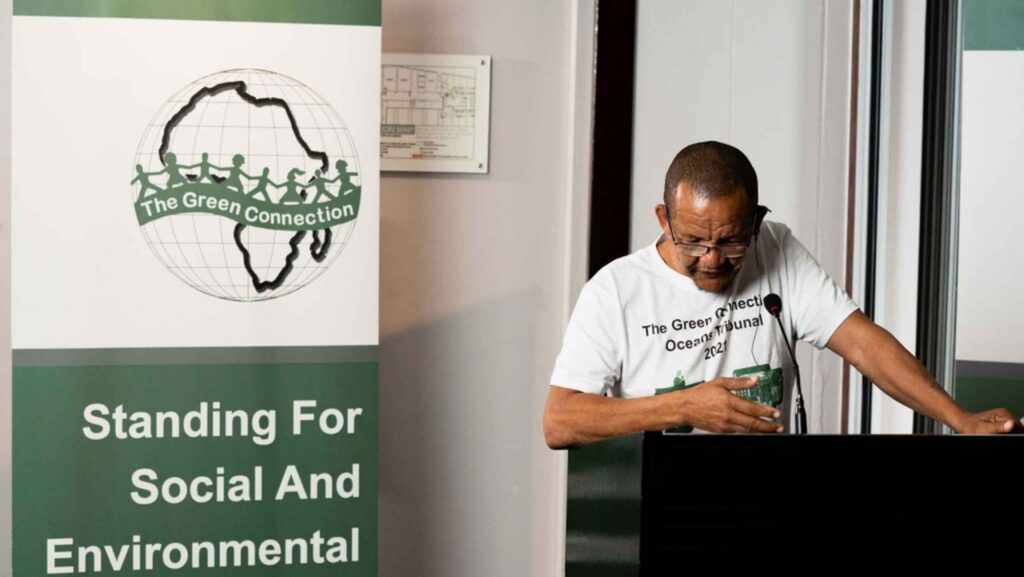
This week, The Green Connection submitted its comments critiquing several aspects of the Environmental Impact Assessment (EIA) process, particularly the lack of procedural fairness, as well as the conclusions reached – notwithstanding information gaps and scientific uncertainty – that should form part Tosaco Energy’s request to undertake various activities in Block 1, off the West Coast.

RECENTLY GRADUATED GREEN CONNECTORS, EQUIPPED FOR THE POLLS AND READY TO WEIGH-IN ON COP26
Following their recent graduation from The Green Connection’s Legacy Champions Programme, these newly empowered Green Connectors say they feel equipped with the necessary advocacy skills to make positive changes in their communities, starting with their vote in the local elections (1 November) and weighing in on the discussions around COP26 (which starts on 31 October) – as part of their efforts to oppose oil and gas developments in the country and offshore.
GREEN CONNECTION’S ‘FUNERAL FOR THE CLIMATE’ (AFRICAN ENERGY WEEK) AND COMMENT ON YESTERDAY’S BUDGET SPEECH
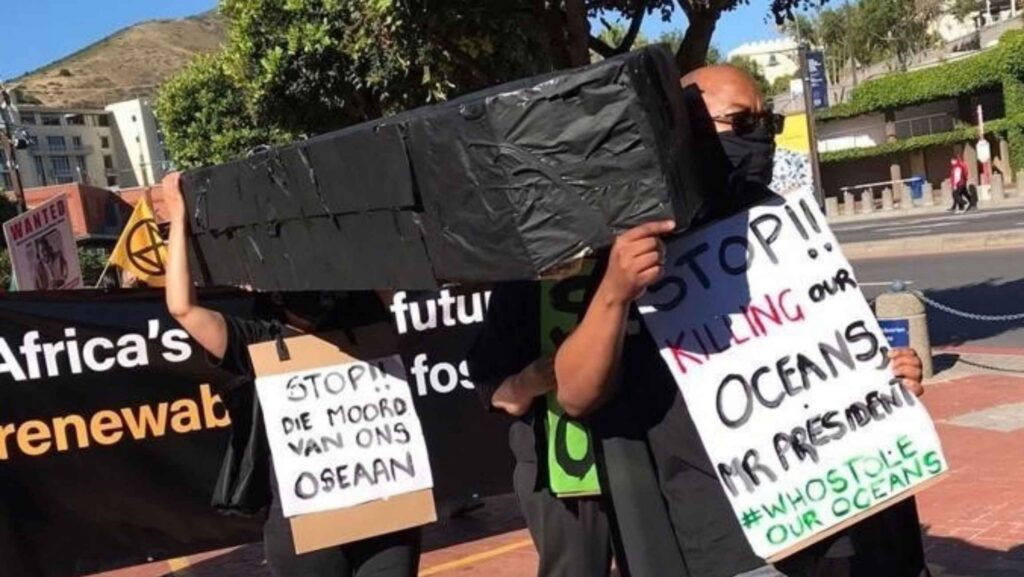
This week (10 November 2021), we joined other environmental defenders in Cape Town to peacefully demonstrate outside the African Energy Week #AEW2021 conference venue demanding an end to fossil fuels and the immediate pivot toward the just transition to a renewable energy future.
CLOSE TO 200 PEOPLE RISE AT CRACK OF DAWN TO PROTEST THE ARRIVAL OF SHELL’S SEISMIC MONSTER, AMAZON WARRIOR
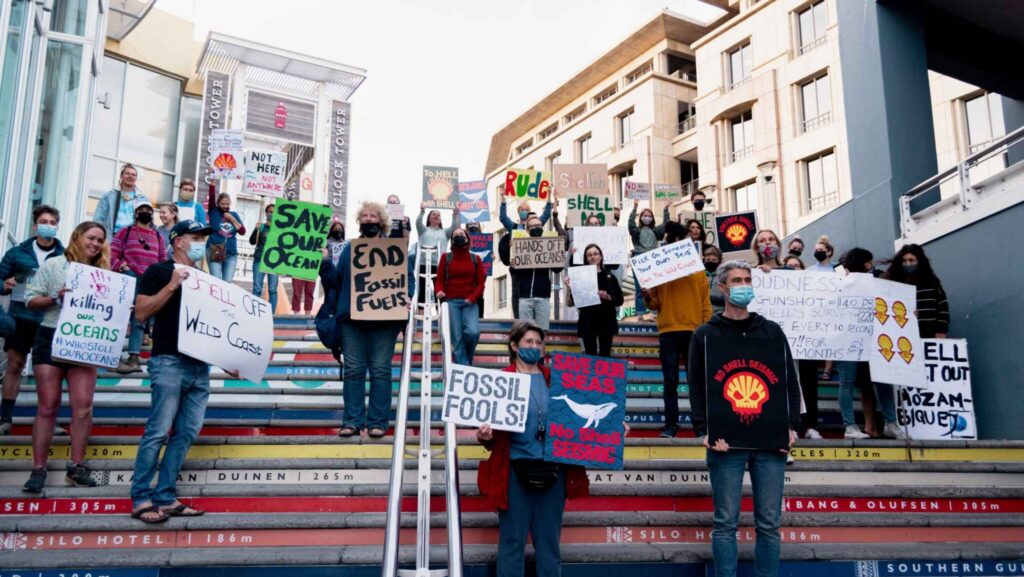
On Sunday morning, (21 November 2021), before the crack of dawn, nearly 200 concerned environmental defenders took to the Waterfront to get a glimpse of Shell’s seismic testing vessel, Amazon Warrior, as it made its way into Cape Town harbour. The vessel travelled down the West coast of Africa, on its way to the Wild Coast, to conduct seismic surveys for an estimated five (5) months.
ENVIRONMENTALISTS DOUBLE-UP ON EFFORTS TO OPPOSE UPCOMING AND FURTHER SEISMIC TESTING IN SOUTH AFRICA’S OCEANS
As the groundswell of opposition against Shell’s upcoming 3D seismic survey off the Transkei builds, the Green Connection – an ecojustice NGO that supports small-scale fishers in advocating for their livelihoods – reacted with astonishment to a press statement issued by the Department of Mineral Resources and Energy (DMRE) on 9 December 2021.
