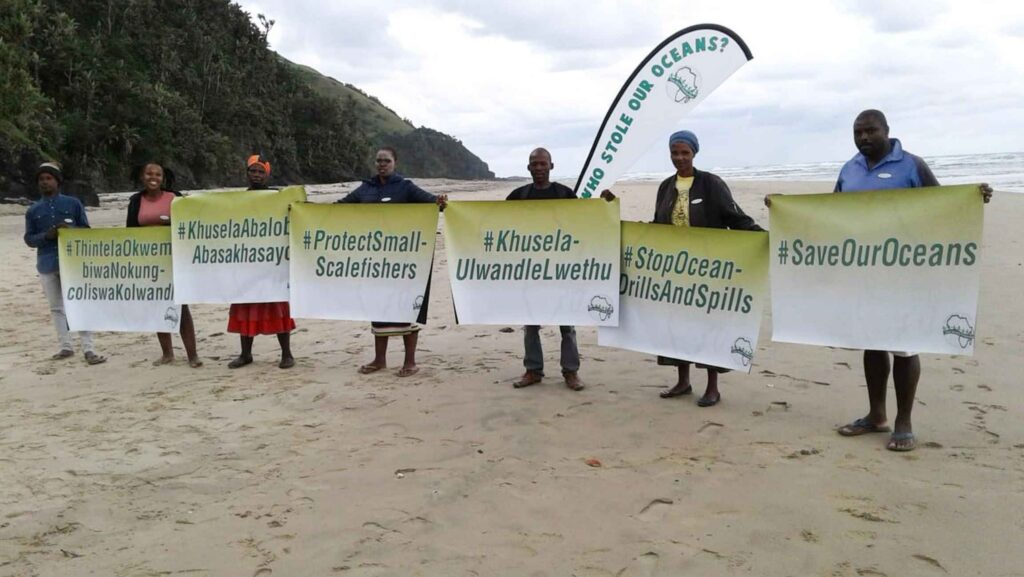
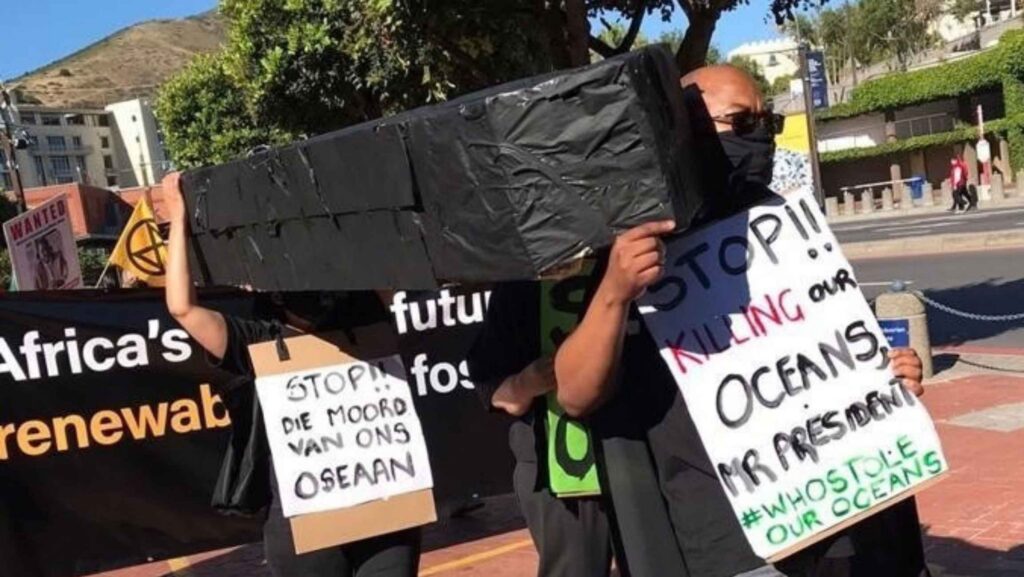
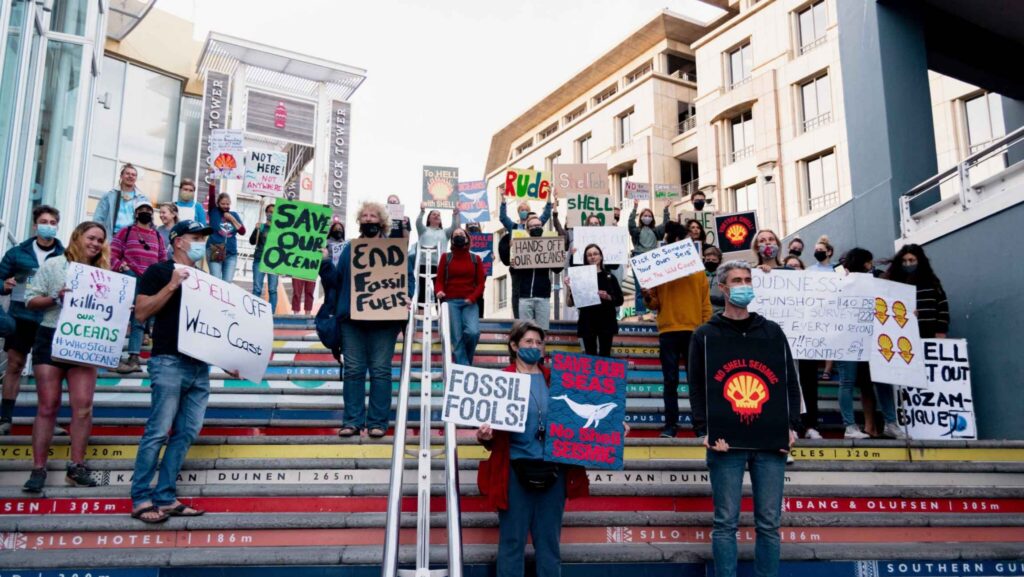
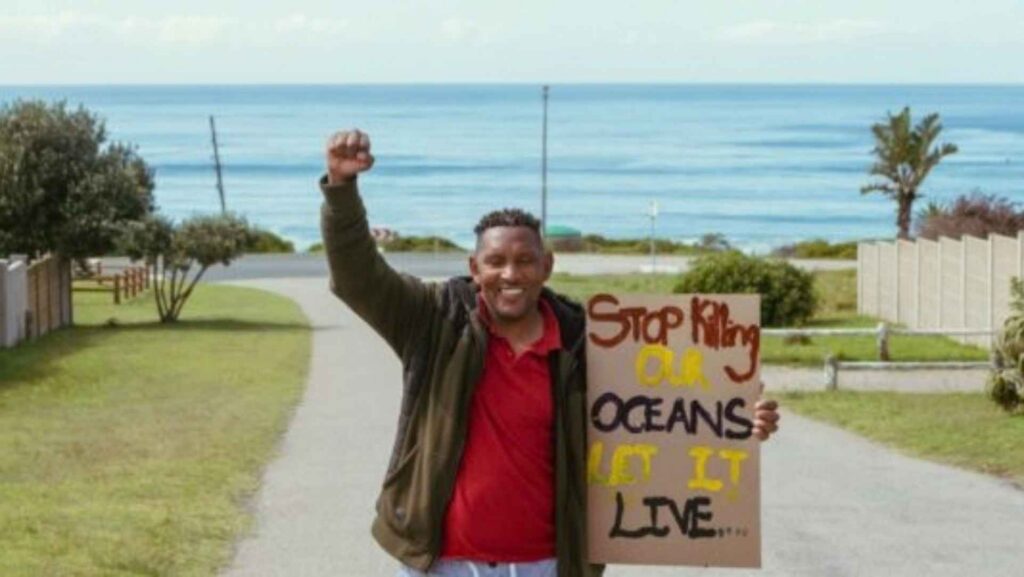
South Africa: On 9 December, people across the country united in local actions against oil and gas exploration and drilling off South Africa’s coastline. Multinational corporations – including Shell, QatarEnergy, Total Energies and contractors such as CGG and Searcher Seismic – are amongst the focal points of this latest public outrage. According to Liziwe McDaid, Strategic Lead at The Green Connection (one of the civil society organisations that got in on the action), “Recent decisions by government to authorise seismic surveys in the Algoa/Outeniqua Basin off the Southeast Coast of South Africa and also off the West Coast, in addition to decision to reject the environmental appeal against oil and gas exploration, from Gansbaai on the South Coast to Doring Baai on the West Coast, has been the catalyst for these actions.”
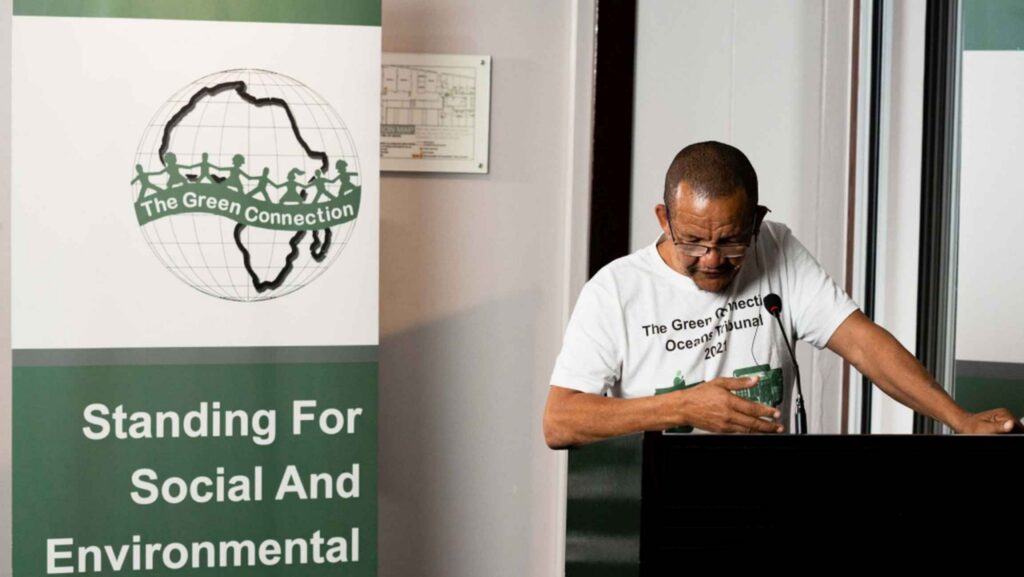
McDaid says, “We believe – especially as it becomes evident that not nearly enough is being done to address the climate crisis – that it is important to show government decision-makers and these oil and gas companies that South Africans are united against climate-change-causing fossil fuels, which also threaten the livelihoods of our coastal communities. This is why, on Saturday (9 December) we joined with people all over the globe, to stand together to oppose oil and gas. There is a climate crisis! We all need people’s power, that is sustainable and renewable, to change from this poisonous power dynamic. In order to shift ourselves to a clean future and to avoid that current and future generations find an almost unliveable planet, we must act now! We call on South Africans to support the NGOs and to join the movement to protect our oceans and marine life, and in the process, safeguard the livelihoods of our local small-scale fishers. We need you, the people, to stand up and join the fight, now. Do not wait until next year.”
The coast to coast action – from KwaZulu-Natal, Eastern Cape, Western Cape and the Northern Cape – forms part of the Global Day for Climate Action. In South Africa, threats to the ocean are central to the fight for climate justice, since the coast is being bombarded with fossil fuel projects.
In Port Nolloth, community activists and fishers took to the beach to voice out their opposition. Local fisher leader Walter Steenkamp says “Oil and gas are bad for our people and oceans and have many negative effects on the livelihoods of fishers who depend on the ocean. We do not need oil and gas when there are other alternatives, like wind and solar, that will not harm the environment and people.”
Also from Port Nolloth, Jeff Van Neil says, “For the small-scale fisher who only knows the ocean as a source of their livelihood, oil and gas has a very negative impact. The government needs to really look into other alternatives and also consult the communities that would be most affected by oil and gas exploration.”
In the West Coast, fishers and concerned community members from Langebaan, Saldanha Bay and Mamre joined in solidarity with fellow-affected coastal communities to protest together at Pepper Bay.
Small-scale fisherwoman Solene Smith from Coastal Links Langebaan says, “Karpowerships, Searcher, Total Energies, Shell and all those other oil and gas companies should leave South Africa alone. What will happen when there is a big oil spill or other negative impacts start affecting us? Why not give us permits to fish, instead of giving permits to oil and gas companies to drill in our ocean? We don’t need any of these Karpowerships in our oceans, and we certainly cannot open our coast to all the risks that come with offshore oil and gas.”
In Cape Town, Muizenberg Beach rang to the calls of “Power to the people!” and deafening cries of “Amandla!” “Awethu!” from the crowd. A diverse group of speakers took to the platform, all with a message which called for oil and gas companies to get out of our waters.
Patrick Dowling from the National Wildlife and Environment Society of South Africa (WESSA) says, “This is another demonstration of civil society’s concern and rejection of the country’s ongoing approval of new fossil fuel-based projects. Karpowerships and deep-sea seismic explorations are being approved by government, and even coal mines are being considered. Some of them are in wildlife reserves. Fracking is still on the table. It is as if the government, which signed the Paris Agreement, does not think about what its commitments should be to the decarbonisation of our country, and in so doing help the world to decarbonise as well. As one of the biggest polluters we should take our commitments seriously and not constantly shift the goal posts to approve new fossil fuel efforts which we know will jeopardise people’s lives, livelihoods and the lives of thousands of other species. The connection between climate change and biodiversity is a significant one.”
Mobilisation Officer at The Green Connection Warren Blouw says, “The people are clear, we do not want oil and gas exploration in our oceans. We don’t want seismic surveys that could harm marine life and destroy the livelihoods of our coastal communities. This has been their way of life for generations. The people’s rights and wellbeing must come before profits.”
Lydia Petersen from Project90by2030 says, “We are very concerned about the licenses that went out rubber-stamping them to explore our oceans and our livelihoods. This is not something that can be undone. It is there and we need to mobilize the communities because after all the oceans belong to us.”
The Green Connection’s Advocacy Officer Lisa Makaula says, “We came out to Muizenberg to protest against all these approvals for offshore oil and gas exploration. We are totally against it because we have seen how it has impacted other countries, particularly in the Niger Delta. We are here to say NO! to oil and gas. We want sustainable development, a future which includes everyone. The people’s concerns must be taken into consideration.”
Wendy Pekeur of Ubuntu Rural Women assembly spoke out, “We are saying no to offshore oil and gas exploration. Millions of lives and livelihoods depend on the fish in the ocean. We can only imagine the devastation it will cause to marine life. When you drill holes in the ocean, it’s holes that you can never repair. The ocean will take so many years to rehabilitate. West Coast and Northern Cape communities, where the drilling is taking place, will be prejudiced if this is allowed. This is in the name of climate justice. We have seen the devastating effects of the storms, the droughts and the heatwaves. This is why we continue to stand up and fight back and not allow mining companies to come in and destroy our oceans.”
Ahluma Pangeni, a youngster working with Project90By2030 says, “We want to stop the drilling of oil and gas in our oceans. We are here for system change because what is happening in our oceans now could affect marine health and the health of our future generations.”
Sarah Robyn Farrell from the African Climate Alliance and Fossil Free South Africa says, “We are saying No! to oil and gas and No! to all the authorisations for seismic surveys and other such actions in our oceans that have recently been granted. We say Yes! to the sustainable development that we want, that is from the people. And No! to putting profit before people.”
Along the south and east coasts, groups of protestors braved bad weather to come out and protest. And in KwaZulu Natal, on Friday, the South Durban Community Environmental Alliance (SDCEA) also held a similar protest.
Further away in Dubai itself where the COP28 is currently taking place, protestors gathered to voice out their concerns. The Green Connection’s Community Outreach Coordinator Neville Van Rooy attended COP28 in Dubai, with Don’t Gas Africa, to address the onslaught of oil and gas projects in Africa and the impact of fossil fuels on climate change and on the health of the environment, and the impact it is having on people’s livelihoods. He says, “As part of its #WhoStoleOurOceans and #TotalDestruction campaigns, our advocacy actions are geared to stop further fossil fuel extraction and to emphasise the need to shift to renewable energy. TotalEnergies have so many projects on the go and/or in the pipeline, here in South Africa, all of which could have serious implications for the health of our oceans and the wellbeing of our small-scale fishers and coastal communities.”
The protest action also focuses on the Kick Total Out of Africa Campaign amid government authorisation of exploration projects off the coast of South Africa.