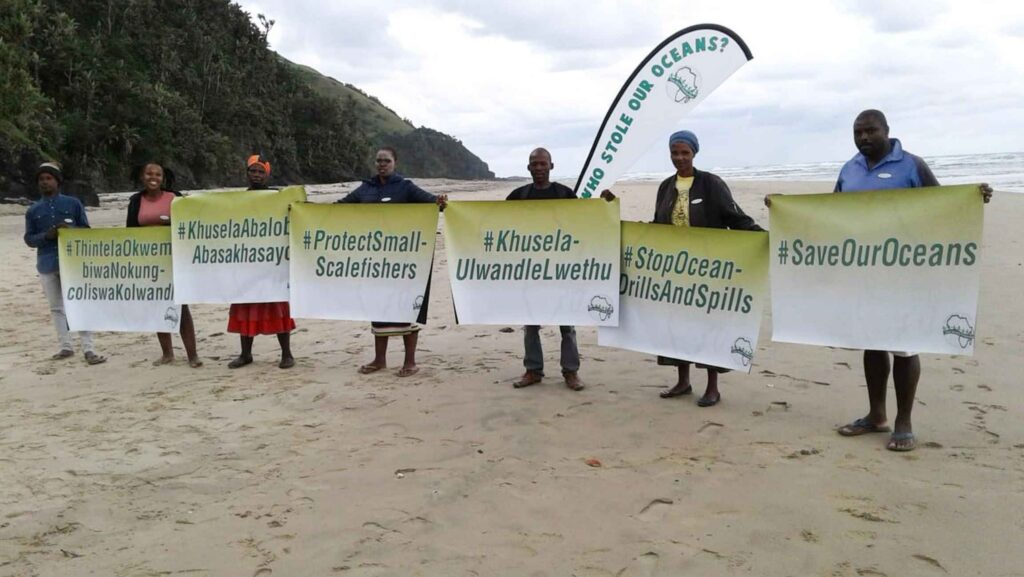
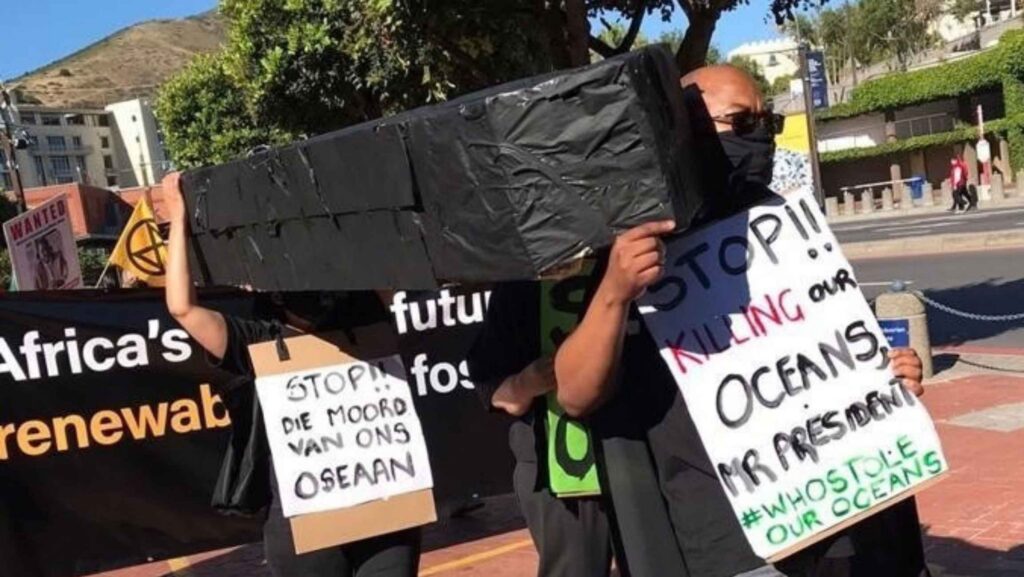
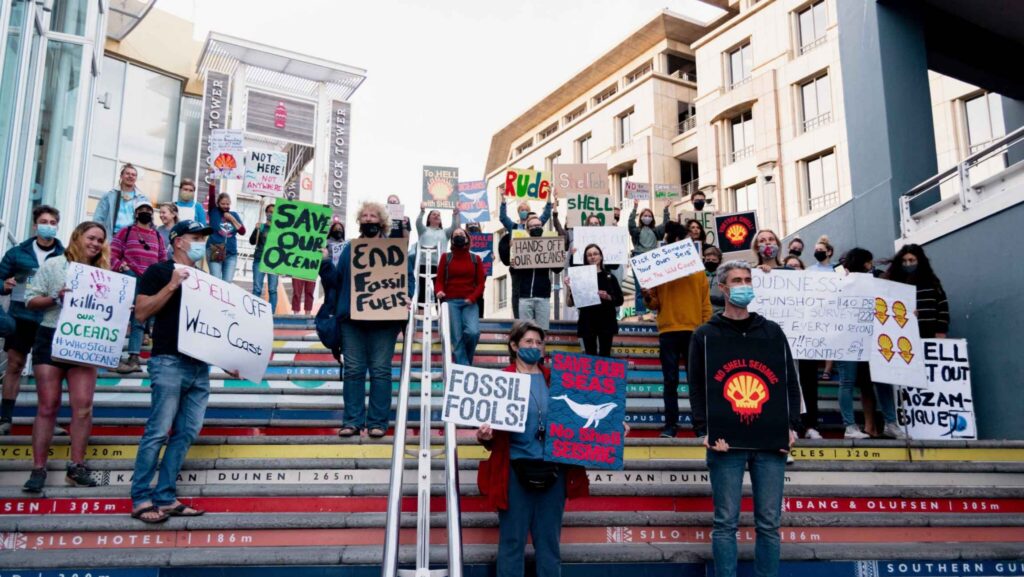
In the midst of the 16 Days of Activism campaign, small-scale fisherwomen from around the country not only have to deal with the gender-based violence issues that plague the women in the country, but they also have to fight to protect their livelihoods from the onslaught of proposed oil and gas projects. For nearly 2 years now (since around March 2021), small-scale fishers and coastal communities – threatened by the negative impacts of Karpowerships and other offshore oil and gas projects – have been publicly vocal about their opposition to these vessels mooring in their bays. The pushback from communities is largely the result of flawed Environmental Impact Assessment (EIA) processes, from a lack of meaningful consultation with those who would be most affected to downplaying (or ignoring) adverse impacts on the ocean, and climate change.
Despite highlighting – through public protests and submissions during the EIA process – the several issues with Karpowerships, which has been controversial from the start, the project still seems to enjoy significant political support. Fisherwomen from the West Coast say that they are becoming increasingly frustrated with individuals, well-known proponents of Karpowerships, who claim to represent them. “We will not be undermined by greedy politicians claiming to speak on behalf of fishers. If these politicians had a relationship with the ocean, as indigenous and career fishers do, then they would have more respect for this resource (which belongs to us all). They would be more committed to protecting the ocean as part of our heritage and for the livelihoods it sustains, rather than to line their pockets.”
There is an overwhelming contingent of fishers who oppose Karpowerships and any further offshore oil and gas projects because of the threat to the ocean and their livelihoods, and because of climate change. In the Western Cape alone there are several small-scale fisher associations – representing entire fisher communities – who do not want the negative side-effects of having these gas-to-power and/or seismic survey vessels harming the oceans. From Coastal Links – which include smallscale fishers from Doornbaai, Langebaan, Ebeneezer, Paternoster, and Velddrift – to Save the Langebaan Lagoon and the South African Fishers Collective, as well as the Red Dust Action group Saldanha and Khoi and SAN group Cochoqua Kingdom Council.
Carmelita Mostert, a fisherwoman with Coastal Links Saldanha Bay says, “Our fisher communities have given no politician the right to talk or make decisions about these oil and gas projects, on our behalf because while they see the ocean as a means of profit, for us the ocean is a part of who we are. It is a precious part of our culture and the source of our livelihood, and our main source of nourishment. For generations we have been here. We have a customary right to make our living and feed our families from a clean and healthy ocean and, as such, we have a responsibility to protect it. We are fishers! It is a huge concern that politicians, who spend no time on sea, seem to use their influence to turn fishers against each other. As we face the climate crisis, which will affect our food security, as indigenous small-scale fishers, we say that it is time that our rights are respected. This includes our right to a healthy environment.”
She adds, “We are all over-40, too old to change our careers. If they take away our livelihoods what will we have left? As a fisherwoman, I work hard to create my living from the ocean. So, when people suggest that small-scale fishing and the offshore oil and gas industry can coexist, I say they are delusional and clearly know (or care) very little for this precious natural resource. Just look at what is happening in Mossel Bay right now, where some kind of oil spill is happening but where very little is known about the source. Who knows how long it has been happening before it became visible? What is the impact to the marine life there? How will the fishers and their families be affected? This is why we keep fighting. We cannot wait till there is no more fish or marine life left in the ocean, to speak up. This is why we continue to shout, “No, to Karpowerships! And no to any offshore oil and gas!”
A fisherwoman with Coastal Links in Langebaan Solene Smith says, “Karpowerships will be detrimental to small-scale fishers. We cannot only look at the economic side of things. We must ask ourselves whose pockets are being lined, through these types of projects, at the expense of smallscale fishers. These politicians have no right to disrupt our communities and cause problems here because our communities already feel betrayed by them. These same people, who are now calling for Karpowerships, did nothing to improve the lives of small-scale fishers when they had the chance. These politicians are not fishers. They have no connection to the ocean, not the way we do. Our love for the ocean runs deep. Our ancestors have died and are buried in these waters. Our cultural identity and our heritage are forever connected to the ocean. Therefore, we fisherwomen are resolved to stand against any project that threatens our oceans.”
Hilda Adams, small-scale fisherwoman from Mamre in the Western Cape says, “We are totally against Karpowerships because of the negative impact they will have on our environment and the livelihoods of fishers who are 100% dependent on the ocean”.
Chairperson of Moeg Gesukkel Cooperative and Secretary of the South African Fisher’s Collective in Eastern Cape Reinette Melisa Pullen says, “We urge that the Karpowerships application be denied because climate change is real and Karpowerships will have high impacts on our climate because of the amount of potent methane (a greenhouse gas) it will emit into the air. Karpowerships will also have a negative impact on small-scale fishers – who have not been properly consulted and included in the process of environmental assessments – and the marine eco-system and environment as a whole.”
Environmental activist from Gqeberha Eastern Cape Vuyiseka Mani says, “A few months back Triplo4 held a meeting about Karpowerships where the turnout was very poor (less than 20 people). At the time, we advised the organisers to mobilize properly for another meeting, to ensure better community representation. Yet, with the next meeting, we were not informed of this, even though we had provided our contact information previously. However, what was most disturbing is that the posters – which were meant to advertise and mobilise communities to join the public meeting – were not from the meeting organisers but from a particular political party. This same political party was arranging the transport to take communities to that meeting. It is very unusual (and in my view, quite unethical) that a political party would mobilise for such a meeting because not all of us affiliate with that particular party. Public participation is supposed to be done by the organisers not political parties who mobilise certain groups affiliated with them, in support of Karpowerships.”